
I learned data science, what now?
At some point you must stop watching YouTube and find a job right?

No one prepares you for what happens when you actually learn the skills to become a data scientist. The most natural answer to this question is: you find a job, but we all know that’s more difficult than you think in today’s age.
Thing is, most people don’t know when they’re ready. Some have imposter syndrome, some are scared of rejection, and some become so addicted to learning and taking course-after course that they don’t know when the time is right. So, when is the right time to start looking for a job?
The only correct answer to this is, when you stop needing and asking for permission.
This is the quiet turning point no one talks about. The moment you realize no new course or certificate will make you feel “ready”
You’ve got everything you need to be ready to start doing. What you lack isn’t knowledge, it’s conviction, direction and a system to turn your skills into something visible.
The truth is, the job market doesn’t reward the smartest candidates; it rewards the most strategic ones. The ones who understand that your résumé doesn’t speak for you — your portfolio does. That every LinkedIn post, GitHub commit, or small freelance project is a signal to the world that you can solve real problems.
So instead of asking, “Am I ready?” start asking, “How can I show what I already know?”
Because that’s where your career truly begins — not in another tutorial, but in proof. In building, sharing, and letting your work speak louder than your hesitation.
So here’s what comes next.
The Portfolio Mindset
You probably already built some projects. But please, don’t put a cat/dog classifier or Titanic survival prediction in your resume. That was your practice baby project. Now is time to build your portfolio so that it not only reflects your skills, but also what kind of impact you’re hoping to make, and your interests too.
Your portfolio should be a mirror of your curiosity — not a playground for random models. Pick 3–5 problems that matter to you or to an industry you care about. Each one should show the full pipeline: from messy raw data to insights or predictions that make sense in the real world.
Storytelling Through Data: Turning Code into Credibility
A good project is not just a GitHub repo, it’s a whole story.
What was the problem? Why did it matter? What was your approach, and what did you discover?
This structure transforms your code into a case study. It helps recruiters, hiring managers, and clients see your reasoning. Use visuals, dashboards, and short write-ups that explain your decision-making process. That’s what separates a coder from a data scientist.
Building Resume That is More Than a Grocery Shopping List
A hard pill to swallow is that hiring managers don’t care about you knowing Python or SQL, or whether you attended the Ivvy League university or community college.
As mentioned earlier, they care about impact, and your ability to frame real world problems into a scalable solution.
Each line on your résumé should answer one question: what changed because of you?
Did your analysis reduce costs, speed up decisions, or improve accuracy? If you’re early in your career, quantify improvements from your projects — even small ones. Numbers make stories believable.
Make Yourself Present, Both Online and Offline
We live in an era where people Google you before they read your résumé.
So make sure your LinkedIn, GitHub, and portfolio site form a consistent narrative.
Your profile headline should show clarity: “Data Scientist specializing in predictive analytics for marketing” is better than “Aspiring Data Enthusiast.” Clarity builds trust; vagueness kills it.
Link your projects, share short posts about what you’re learning, and let your presence work for you while you sleep.
Networking is underrated. Engage with data science communities on LinkedIn, Slack, or Discord. Comment on posts, share your projects, and make your name recognizable before you send your résumé.
No matter where you live, every month you can find some local events relating to web development, AI or just technology in general. Those can be conferences, meetups or even just gaming competitions (I actually found a long-term project by connecting on a Tekken 7 competition, haha)
Apply Smart: Visibility Beats Volume
Once you start applying, it’s tempting to go wide, hundreds of résumés, endless job boards, a dozen “Easy Apply” clicks before breakfast. But the reality is, you don’t need a hundred chances. You need the right ten.
Smart applications are targeted, personal, and strategic. Instead of blending into the noise, learn how to stand out — tailor each résumé to the company, mention specific problems you can help them solve, and attach a project that proves it. Most people never do that, which is exactly why it works.
And here’s what most beginners overlook: opportunities don’t live only on LinkedIn. You can create them. Cold outreach is one of the most underrated career accelerators in data science. Write to founders, small business owners, or department heads. Offer to help them make sense of their data — visualize their sales, find patterns in customer behavior, or automate their reports.
Even door-to-door, offline pitching still works. Walk into a local café, fitness studio, or shop and offer to analyze their customer data, social media metrics, or inventory. It’s scrappy, yes — but it’s also how you turn skills into experience and clients into testimonials.
The hidden truth? You don’t need permission to start working as a data scientist. You just need one person to say yes. And that person might not even be a recruiter.
Consider Freelancing Before You’re Ready
Start freelancing before you feel ready, because the freelance world rewards execution over perfection.
You don’t need to wait for a job title to start working as a data scientist. Begin small by cleaning spreadsheets, automating reports, or creating dashboards for local businesses. Each project you complete teaches you more about real data, deadlines, and client expectations than any course ever could.
When you build something useful and share it publicly — whether it’s a dashboard, a mini AI app, or an insightful analysis — you show initiative. One real project that solves a problem will open more doors than a hundred applications ever will.
The secret? Many freelancers earn more than FAANG data scientists because they work for multiple small businesses and automate their performance, or with startups affiliated with FAANG.
I actually have a Freelancing Roadmap and it comes with free Upwork e-book, check it out if you’re interested in starting your freelancing journey. I have 9 years of experience and I never looked back.
Keep Learning, But Let Experience Guide You
After the fundamentals, stop chasing every new buzzword.
Your next learning step should come from your work — not from random YouTube recommendations.
If your projects fail due to deployment issues, learn MLOps. If your clients ask for dashboards, master Power BI or Streamlit. Experience should lead education, not the other way around.
Build a System, Not a Schedule
Most people quit after 2 weeks of applying. Why?
Because they have no system.
Design one. Set weekly goals: two applications, one new portfolio update, one post on LinkedIn, one outreach message.
Momentum compounds — not luck. The people who seem “lucky” just have consistent systems that keep them visible.
And if you don’t know how to make that system, use mine.
I mentored 117 data science students and juniors/intermediate data scientists and ML engineers, I packaged everything I’ve learned in a comprehensive, dynamic and interactive Data Science OS equipped with strategies on how to start your data science business, make multi 6-figure salaries as a data scientists and a 30-day content plan for LinkedIn
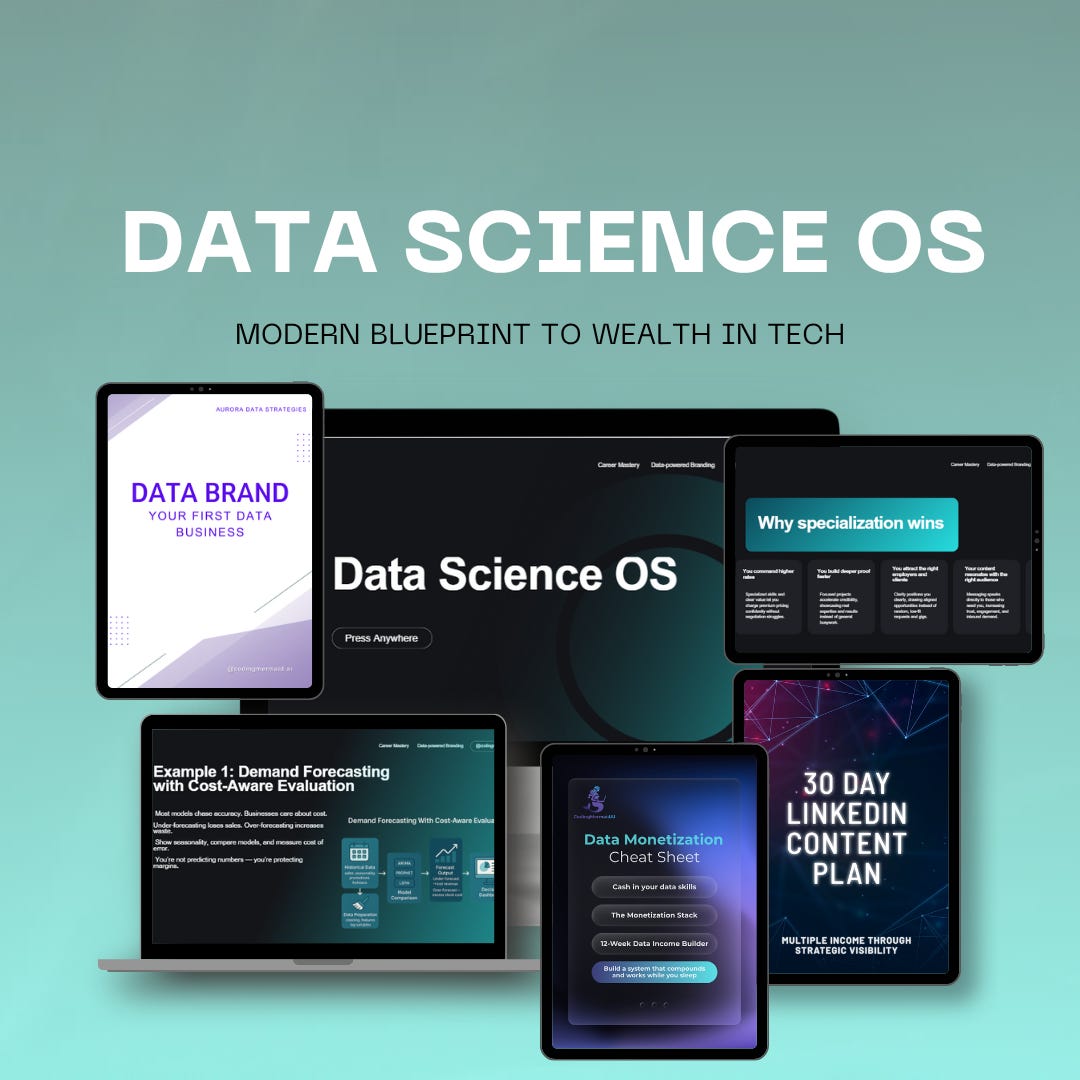
Sign up below, I may remove it soon!
Until next week besties
Talk soon
Danica